


How the next generation is redefining yacht ownership

By Chloé Braithwaite
27 February 2026
Share


All grown up and ready to take on the yachting world
It’s February in Kitzbühel. Snow-dusted peaks, crisp alpine air—this is hardly the place one would expect a gathering of top minds from within the superyacht industry.
But here it is: the Superyacht Design Festival (SDF). Held 1-3 February 2026, the event brought together owners, designers, and industry thinkers for three days of conversation.
If one theme emerged throughout, it was this: the age of the superyacht owner is changing, and it’s changing fast.
This is a major generational shift. Where the archetypal buyer of the previous generations tended to be in their mid-to-late fifties, research from the International University of Monaco, as well as that of leading shipyards, point consistently in the same direction: the average owner profile is trending towards the 35-45 age bracket.
These younger superyacht owners bring with them a shifting set of wants and priorities, and—importantly—a fundamentally different idea of what a yacht is for.
This isn’t a cosmetic shift—not entirely. The next gen yacht owner arriving in today’s market isn’t looking for a floating palace. They want a high-performance platform for living, one that respects their time, sharpens their focus, and keeps them connected rather than cut off.
What were once the defining status symbols of the superyacht world—grand saloons, formal dining rooms, sweeping staircases built to impress—are giving way to something more considered.
Throw that rulebook overboard. Here’s what matters now.
From status symbol to experience platform
Perhaps the most striking session at SDF 2026 may have been the one that started furthest from the yachts.
What does Gen Z actually want?
That’s the question Jenk Oz, founder and CEO of Thred Media, sought to address. As one of the sharpest voices on what Gen Z yacht owners really want, he put it plainly: for this generation, a yacht isn’t a trophy as it once was for the generations before. Instead, it’s a tool for impact and personal wellbeing, a means of living better, more intentionally, more connectedly.
That shift in intent demands a corresponding shift in design, and yacht designers across the industry are responding accordingly.
Enter neuroarchitecture.
Fiona Beeken’s keynote moved the conversation far from soft furnishings and colour palettes. Neuroarchitecture—designing spaces informed by how the brain responds to light, proportions, texture, and spatial proportion—is beginning to reshape how superyachts are conceived from the inside out. While beautiful interiors are always the goal, they go beyond appearances to measurably reduce cortisol levels, lower the body’s stress response, and create what researchers describe as an ‘alpha state’ of calm, focused relaxation.
In practice, this means leaving behind the formal, rigid layouts that defined superyacht interiors for decades. That vast dining room, built to host a dinner party and serve no other purpose? Gone, or at least rethought. In its place: adaptable spaces that shift fluidly between work and leisure. ‘Work-from-sea’ zones that transform from a focused workspace to a relaxed social setting without ceremony. Wellness amenities that go far beyond a sauna: biohacking labs, circadian lighting systems, air purification, thermal contrast therapies.
The Gulf Craft Majesty 100 Terrace, winner of the Outstanding Lifestyle Feature award at the BOAT Design & Innovation Awards 2026, captures precisely where today’s yacht is heading. Its 270-degree owner sanctuary isn’t opulence for opulence’s sake. It is deliberately, intentionally human; a private refuge designed for those who need somewhere to actually think, breathe, and exist outside of the noise of ordinary life.
For the younger generations now shaping yacht ownership, this is the new baseline, not a luxury.
Silent luxury and the digital nomad CEO
There is a quiet revolution (pun intended) underway in the yachting industry, and it’s redefining what performance means entirely.
For the next-gen yacht owners who are often working CEOs, founders, and investors with no intention of fully unplugging, the engine room of the modern superyacht is not the mechanical space aft; it’s the connectivity infrastructure. High-speed, reliable, global internet has moved from a desirable feature to a non-negotiable.
In 2026, Starlink Maritime and hybrid satellite solutions are a base specification—no longer just a selling point—as fundamental as a working galley. A vessel without robust connectivity is, for this owner profile, essentially unusable.
This creates a new operational discipline that the superyacht industry is only just beginning to take seriously: cybersecurity. As today’s yacht becomes a data-dense hub—streaming, video conferencing, smart systems, remote monitoring—it also becomes a target. Enterprise-grade firewalls and network segmentation now belong outside of corporate IT departments, part of a vessel’s management plan and built into its operational architecture from day one. Invisible, until the moment it matters enormously.
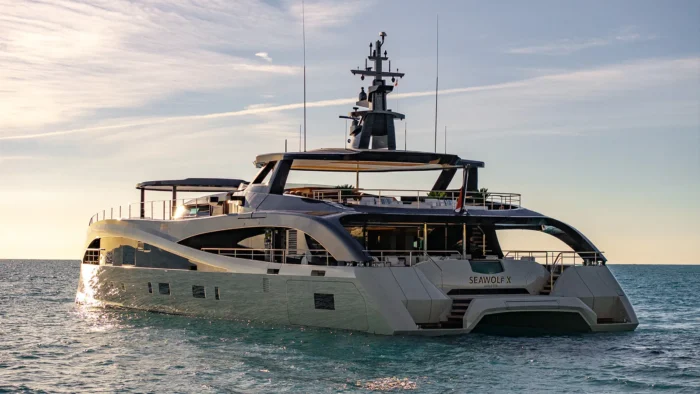
And then there’s the other kind of silence: the kind that greets you at sea, where all you can hear is the lapping of waves against the hull rather than the roar of engines. SEAWOLF X offers one of the most compelling visions of where propulsion is heading: AI-driven energy management that intelligently balances hybrid propulsion systems to achieve zero noise and zero vibration during those precious hours at rest. Pair that with solar panels integrated into the vessel’s structure, and you begin to see a future where the yacht works with the environment, not against it.
No generator hum. No acrid diesel scent drifting across the morning air. Just the sea doing its thing.
For an owner whose days are relentless, filled with board meetings, global travel, the constant low-level hum of demand, that silence is the whole point.
Sustainability as a financial and regulatory imperative
For a long time, sustainability in the superyacht world was approached incrementally: solar panels installed on the sundeck; a more efficient generator—small, visible wins that reduced carbon footprints without fundamentally changing how a vessel was designed, managed, or operated. The intention was there, of course. But the ambition rarely went further than the low-hanging fruit.
That’s changing fast, driven from two directions at once: tightening regulations, and the owners themselves.
2026 marks a genuine regulatory inflexion point. The expanded EU Emissions Trading System and the incoming FuelEU Maritime regulations are reshaping the cost structure of yacht ownership, and while the immediate direct impact on private superyachts varies by size and use, the direction of travel is unambiguous. Sustainable products and practices are becoming a cost-management strategy.
Millennial yacht owners are particularly attuned to this. According to Morgan Stanley’s 2025 Sustainable Signals report, 80% of Millennial and Gen Z investors plan to increase their sustainable investment allocations. Shockingly, 99% of Gen Z respondents express interest in sustainable investing altogether.
This cohort does not separate its values from its assets. A vessel that cannot demonstrate environmental credibility is, in the eyes of the younger generations entering the market, a liability.
The case for genuine focus on sustainability and responsible ownership models is also one of protecting exit value. A vessel not be future-proofed against tightening regulations—one that cannot be readily assessed against emissions benchmarks, fuel efficiency standards, or green certification frameworks—will depreciate faster than its owners anticipates. The legacy asset problem is real, and it affects yacht owners and charter guests equally; the latter are increasingly choosing vessels that reflect their own values.
Technical management is what bridges the gap. Rigorous, proactive management, covering fuel optimisation, emissions monitoring, hybrid propulsion retrofitting, and compliance documentation, is the difference between a smart acquisition and an expensive one.
Carbon footprints will matter more to the next generation of buyers than they do today. The time to address them is now.
#YachtTok and the new visibility: from secretive to storytelling
Not so long ago, superyacht ownership was defined by a kind of studied discretion. The finest vessels were the ones nobody talked about.
But younger generations want to talk. These new owners have grown up in a world where visibility is currency, and for a growing number of them, their vessel is not a secret to be kept.
They’re stories worth telling.
Social media has been the catalyst. What was once a closed world, visible only to those within it, has opened up across Instagram and TikTok, and a new generation is discovering that the yacht industry is about far more than champagne on a sundeck in Saint Tropez.
The Xplorer 60 AFTER YOU—a finalist at the BOAT Design & Innovation Awards 2026—embodies this new sensibility. It was designed to take its owners to places that most yachts, and most people, will never reach, not just to sit pretty in port. It’s a story of possibility, not opulence; the kind that works well on social media, and one that speaks directly to charter guests and owner-operators alike who want their time at sea to mean something.
Marine conservation, remote exploration, purpose-led itineraries: the next generation is using their superyacht as a platform, and the audience is paying attention.
Thinking about your next move on the water?
We would love to have a conversation. Get in touch with the Moravia team and let us help you find the right vessel for the life you want to live.
 Previous news article