


How to chase a solar eclipse by superyacht

By Chloé Braithwaite
29 July 2026
Share


The open ocean is the ultimate front-row seat for 2026’s rare sunset totality
It’s not often the world of yachting and astronomical phenomena converge, but what better way to stargaze than in the middle of the sea, away from city lights?
On 12 August 2026, the Balearic Islands and the coast of Iceland will be in the path of totality for a total solar eclipse. We will also see a total solar eclipse in 2027 along the North African coast and the southern coast of Spain, while in 2028, the eastern coast of Australia and the South Island of New Zealand will be in the path of totality.
So, how do you chase an eclipse by superyacht? Dr Nick Cvetojevic, an astronomer with the Observatoire de la Côte d’Azur—an astronomical observatory based on the French Riviera—explains what a solar eclipse actually is, how to view it safely, and what to pay attention to.
What is a solar eclipse?
In the simplest terms, a solar eclipse is when the moon passes directly in front of the sun, Nick explains. This causes a shadow on the earth. If you’re standing in the shaded part of the earth—this year, ranging from Iceland down to the south of Spain—and look up at the sun, it’ll be completely blocked by the moon.
“While this might not sound very impressive, when you are living through it in person and watching the daytime slowly turn to night, stars coming out, birds and bugs going crazy, it truly feels that the laws of nature have just been flipped on their head,” Nick laughs. “It’s an experience you will never forget.”
How long the solar eclipse lasts depends on the location.
“And a bunch of complicated geometry: the exact position of the moon, the sun, the time of year, and where you are watching it. For this year’s eclipse, you are looking at about one minute and 30 seconds at most places. For those interested, the longest possible duration is about 7 minutes and 30 seconds, which will occur on 16 July 2186 in Colombia and Venezuela. The last time this happened was 15 June, 743 BC!”
As an astronomer with intimate experience of the night sky, he is still left awestruck by the occasion.
“Eclipses are ephemeral phenomena, a chance occurrence in space and time,” he smiles. “But I feel that people don’t truly appreciate just how ephemeral it is when compared to life on earth. Our moon, Luna, used to be much closer to Earth in the distant past, and the same tides that superyachts navigate every day are pushing the moon away.
“Right now, as it appears from Earth, the moon happens to be almost the exact same size as the sun from our perspective—but in a few hundred million years, the moon will be too far away to make a totality on Earth, and total solar eclipses will never be seen again on this planet. The cosmic dance continues, but for a brief moment, there lived a species on a little blue planet that thought the moon’s shadow was just the coolest thing ever.”
Where is the solar eclipse in 2026?
“The north and Andalusian coasts of Spain would be fantastic,” Nick recommends.
“The northern coasts between the Basque Country (Bilbao) and A Coruña will have totality, with Gijon being close to the centre. The southern coast between Tarragona and Valencia should have totality, but I’d personally recommend the Balearic Islands, like Palma or Ibiza. Sunset eclipses are rare and amazing, and you have the best chance of good weather this time of year. Plus, there is plenty to do in the days leading up to and after the eclipse.
“If you find yourself much further north, the totality will also be on the western coast of Iceland near Reykjavik.”
Where to watch a solar eclipse on a superyacht
The good news is, duration-wise, there is only about 30 seconds’ difference between being perfectly placed in the centre of totality compared to being at the edge of it.
“However, there is a big difference if you are in totality or not,” Nick explains. “If you are too close to the edge and are unlucky, you will get close, but not full darkness, so in my opinion, it’s better safe than sorry. Get as close to the centre as is convenient, but don’t stress too much over the exact spot. Every spot you can conceivably see from where you are standing will get the same time and view as you.”
Of course, while we know the path ahead of time, the one thing we cannot predict is the weather.
“If it’s cloudy, you obviously won’t see much. It will still turn to night-time, which, without the warning of watching the sun get thinner and thinner, can come as quite a surprise. But you will miss out on seeing any detail of the sun, so keep an eye out for the forecast a day or two in advance and for details during the day.”
For those in the Mediterranean, and especially near Palma, there is an extra advantage and a disadvantage.
“Because the eclipse will be happening close to sunset when the sun is low to the horizon, the photos and visuals will be unmatched, as now you will have something in the distance to get a sense of scale—a bit like how sometimes people think the moon is bigger when close to the horizon; it isn’t, but since you have a tree or house far away for size reference, your brain is tricked.
“The downside is that you are looking through much more atmosphere, and those who have spent a lot of time watching sunsets on superyachts will know that the chance of there being a cloud in the way is pretty high.”
The solution? Perhaps the next bay over. The path of totality itself is approximately 180 nautical miles, so speak with your captain to determine the best location for your view.
“But remember, much like chasing the Northern Lights, this is an ephemeral experience that cannot be controlled by humans; don’t be too disappointed if you miss it for any reason. There is a total solar eclipse happening somewhere in the world every 18 months, give or take. In 2027, it will be in North Africa and the Middle East; after that, in 2028, it’ll be over Australia and New Zealand, passing through Sydney. For those with the means and ability to travel, there is no reason that an eclipse is a once-in-a-lifetime experience.”
How to (safely) watch a solar eclipse
Under no circumstances should you ever point a pair of binoculars or a telescope directly at the sun. You need a simple pair of eclipse glasses—“typically plastic on paper, and inexpensive,” Nick says. At sea, you cannot use a telescope out of the box; you’ll need a gyro-corrected telescope as any tiny movement of the vessel will result in huge movements through the lenses.
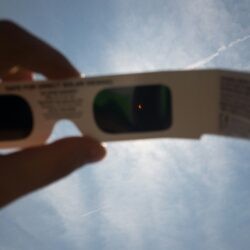
“However, if a telescope or binoculars are used, they must have the appropriate filters placed on the front—my personal favourite is the H-α filter, where you might see some flares as well, and can be used as you’re waiting for totality to start. But please, use your judgment before looking at anything pointing at the giant ball of nuclear fire.”
Astrophotography will require a specific set-up—the right gyro-corrected tripod, the right filters, the right camera—but forget your iPhone: you’re unlikely to get a good shot.
“Put the smartphone away!” Nick laughs. “I always like to tell people to see the detail, but then to step back and see what it does to the world around you.”
Detail-wise, with those eclipse glasses, you’ll want to see the solar corona: a super bright and super hot part of the sun’s ‘atmosphere’ that’s normally impossible to see due to the glare from the sun itself, “but with the moon blocking the main bright part of the sun, the corona becomes visible. It should appear as if the moon has wisps of fluff around it.”
But the other thing to do is to simply pause.
“Take your eye off the eclipse itself,” Nick advises. “Look at the sea all around you, and notice how the darkness, the glow, affects nature itself. Notice what the birds are doing, how the sounds of wildlife change all around you. Try to notice the stars too, if possible, as they don’t often get captured in the photos.
“I’m sure this will come as a surprise, from the mouth of a scientist, but having the day suddenly turn into night is a supremely jarring experience. Knowing the science of why this is happening in no way prepares you for the eerie feeling that it sends down your spine. It can be quite a spiritual and humbling experience for a little human interacting with the vast cosmos.”
Planning to charter for the 2026 or 2027 eclipse?
Our team can advise on vessel selection, positioning, and itinerary design. Contact our charter team.
 Previous news article