


Art at sea: Alan Walsh on why the best superyachts take collecting seriously

By Chloé Braithwaite
22 May 2026
Share


On what to buy, how to protect it, and why the only brief that matters is you
Walsh mentions it almost in passing: he has never drawn a face.
Not since he was 14, when a creative director at a Leeds advertising agency told him to stop worrying about the features and let the body language do the work. He hasn’t drawn one since.
His paintings—bold, graphic, faceless figures caught mid-gesture against flat planes of colour—are now in the collections of royalty, Formula 1 drivers, and musicians, displayed on the walls of superyachts moving between Monaco and the Caribbean with their owners. He’s spent years watching his commissions leave his studio and disappear into the world.
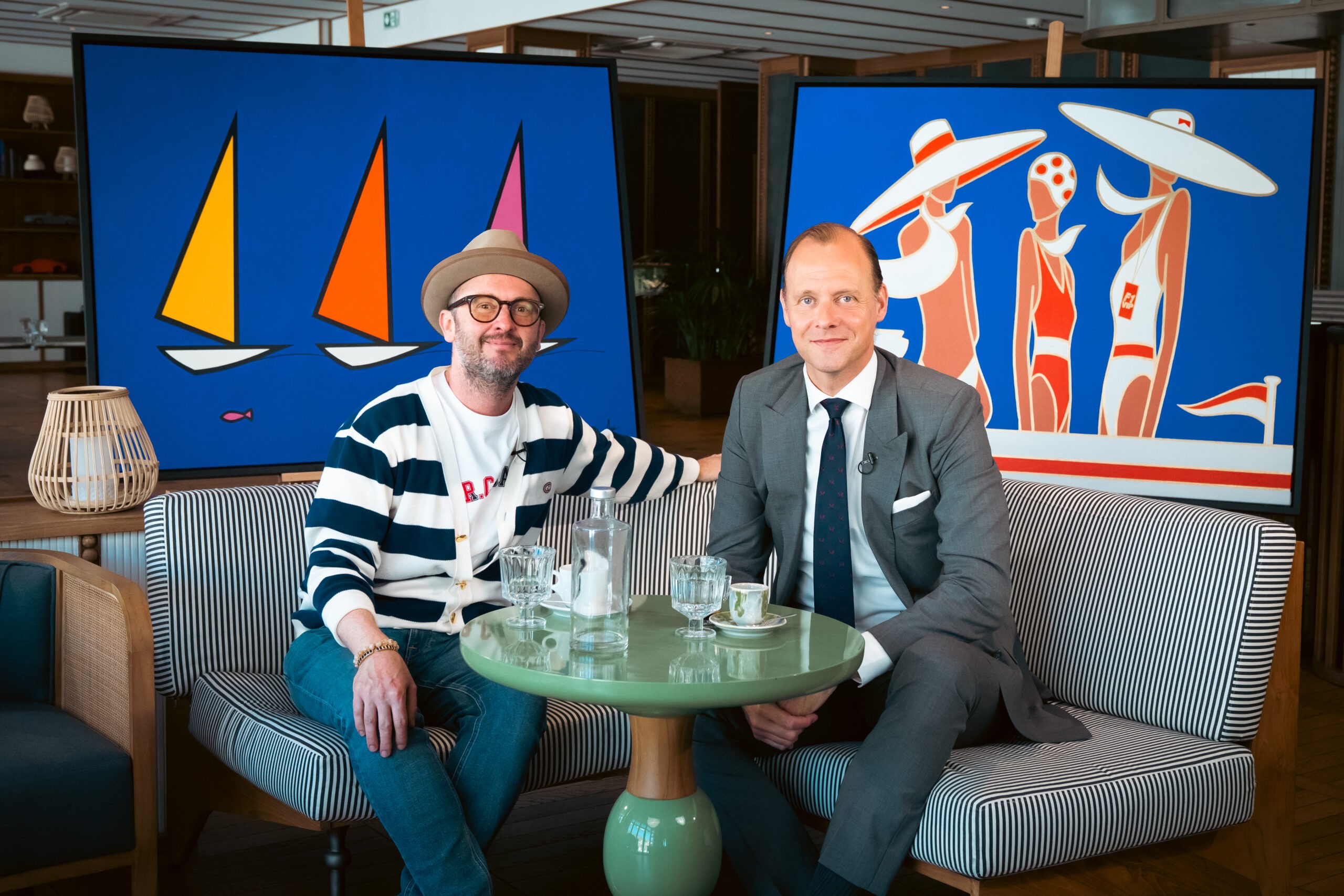
Ahead of Monaco Art Week 2026, Moravia’s COO Frédéric Dormeuil sat down with Monaco-based artist Alan Walsh to begin this conversation. Watch the full version on YouTube.
We followed up with Walsh to go deeper. Here’s what he had to say.
What makes a superyacht different as a space for art
Ask Walsh what separates a superyacht from a house or gallery as a space for art, and his answer is simple.
“The general relationship between a viewer and a piece of art is the same,” he says. A superyacht might not be a gallery, but it’s not as different as one might assume.
What changes, he argues, isn’t the art, but the viewer.
“Perhaps the connection can be deeper, because the viewer might be more relaxed, less stressed if they’re on vacation and have a bit more time to appreciate the art.” The observation is more pointed than it sounds. Most people speed through life in constant motion—passing a canvas in a corridor, glancing at a print between other things. But at sea, the rhythm of life changes. There’s nowhere else to be. On a yacht, people have time to really see.
What collecting well at sea actually looks like
That quality of attention is precisely why the question of what you put on the walls deserves thought. Walsh’s most useful distinction is a simple one: how are you planning on using the yacht?
“The first question I would be asking is how much time the owner is going to spend on the yacht personally. If it’s a boat they’ll spend a lot of time on themselves, then it makes sense to invest in art that they connect with.”
But if the vessel is primarily for charter?
“If the owner will only spend short periods of time and it’s often out for charter, then the art would most likely be less personal to them, and an interior designer could help choose works that might appeal to a wider audience.”
It’s a cleaner framework than the usual advice to simply invest in quality. A personal collection aboard a yacht you live on for months calls for the same instinct you would bring to hanging in your home; intimate, more idiosyncratic. While charter yachts—with clients from all over the world—need a far more crowd-pleasing eye.
What art needs to survive on board
But knowing what to buy is only half the question. What you do with it once it’s aboard is an important consideration, because the cost of getting it wrong is so high.
“A common mistake I’ve seen is purchasing artworks on paper—such as screen prints—and seeing them ripple and fade due to extreme changes in climate, sun, air conditioning, and direct light.”
His recommendation is UV museum glass, used without exception, and where possible, paper works mounted flat to prevent movement. For his own clients, Walsh has developed a practical alternative: producing works under anti-reflective UV perspex, which offers the same protection without the fragility of glass in a marine environment.
Positioning requires equal care. Any work placed where it might be exposed to sea spray is the wrong location, as is intense all-day sun; both cause damage that accumulates slowly but irreversibly. In areas with particularly harsh lighting, non-reflecting museum glass reduces the glare from bright reflections without compromising the piece’s quality.
And on the question of what art works best in that environment, Walsh looks to pieces with warmth and energy: nautical references, sun-drenched Riviera themes, figures that suggest sunshine and ease. These tend to hold their mood in such spaces.
“Avoid anything too heavy, too moody, too wintery,” he advises. On a vessel where the point is to feel well, the art should be doing the same work.
His own style travels well for a reason. “My works are bright and bold, so they lend themselves well to ever-changing light conditions.” That’s not to say one aesthetic holds up over another, but it does illustrate something broader. Clarity of image and strength of colour hold up where natural light is strong, shifting, and at times unforgiving.
When the work takes on a life of its own
Once a piece leaves Walsh’s studio and goes aboard a vessel, it enters a different kind of existence than his studio, moving between climates, countries, and guests, accumulating a life he doesn’t get to see.
“A lot of my clients move around the world all year round, so it’s not something I really think too much about,” he says. But there are moments when that itinerant life becomes vivid. “It’s always lovely when a client invites you back on board a year later after commissioning some art and seeing the works hanging and bringing a wall to life. That’s a good feeling.”
For anyone approaching art for a superyacht seriously for the first time, Walsh brings it back to something simple: “Choose something you connect with and you enjoy.” It does not require a curator or a ceiling budget, but it does require the choice to be genuine for a piece to be worth coming back to long after the novelty has settled.
Moravia Yachting is a proud sponsor of Monaco Art Week.
Curious about what a superyacht of your own could look like?
Our team is happy to help find the perfect vessel for you. Get in touch.
View full interview:
 Previous news article