


How to buy an explorer yacht: Specs, costs, and what owners wish they’d known

By Chloé Braithwaite
22 May 2026
Share


Everything you need to know before you sign anything
There was a time explorer yachts—also called expedition yachts—were the unique realm of commercial operators: oceanographers, fishing vessels, the rare, wealthy National Geographic-type citizen scientists.
But by the start of 2026, there were 101 expedition-oriented vessels in build or on order. That’s the second highest figure ever recorded, according to Boat International’s 2026 Global Order Book, and part of a growth curve that could see as many as 315 explorers delivered within a single decade by 2030. That would represent an increase of more than 80 percent on the previous 10 years, which were themselves already the highest-performing decade in the category’s history.
Specifically, pocket explorers—vessels between 24 and 40 metres—now account for 72 percent of explorer deliveries. Now, explorer yachts are more accessible than ever, thanks to advances in technology and engineering that mean even smaller lengths have decent range and self-sufficiency.
But market momentum does not—and should not!—make a purchase decision. Explorer yachts are necessarily technically complex vessels, and the difference between one with decent specs versus one with an explorer yacht-inspired profile can have big budget consequences.
That’s why explorer yachts aren’t for everyone, says Sam Tucker, Sales Broker for Moravia, whose portfolio spans several expedition yachts.
What is an explorer yacht?
There isn’t a formal, industry-wide classification for the term explorer or expedition yacht.
What distinguishes these vessels from other long-range motor yachts is a combination of design decisions: extended range and fuel capacity, a hull optimised for seakeeping in exposed conditions, enhanced autonomy in terms of provisions and fresh water, engineering redundancies built in, and the structural capability to operate in challenging environments.
“I suppose, if they needed a definition, at its simplest, an explorer yacht is designed to take owners well beyond the established cruising circuits while remaining comfortable, safe, and self-sufficient for extended periods,” Sam explains. “When it comes to explorers, the most important things to assess are range and autonomy. You need to have enough fuel to get where you want to go, but you also need to consider self-sufficiency when it comes to things like provisions: having enough food on board, enough storage and freezer space—you may not be able to dispose of waste for weeks at a time—as well as spares, engineering parts, and watermaking facilities.
“Of course, it depends on how and where you plan to use the vessel. Explorers aren’t a one-size-fits-all. There isn’t one checklist for every programme and expedition.”
It’s also a question of hull design. You’ll need displacement or semi-displacement hull forms that sit in the water and push through it, rather than riding on top of it. This makes them more fuel efficient at the low speeds of long-range passage-making, and more stable in the kind of conditions you may encounter once you leave calm, familiar waters.
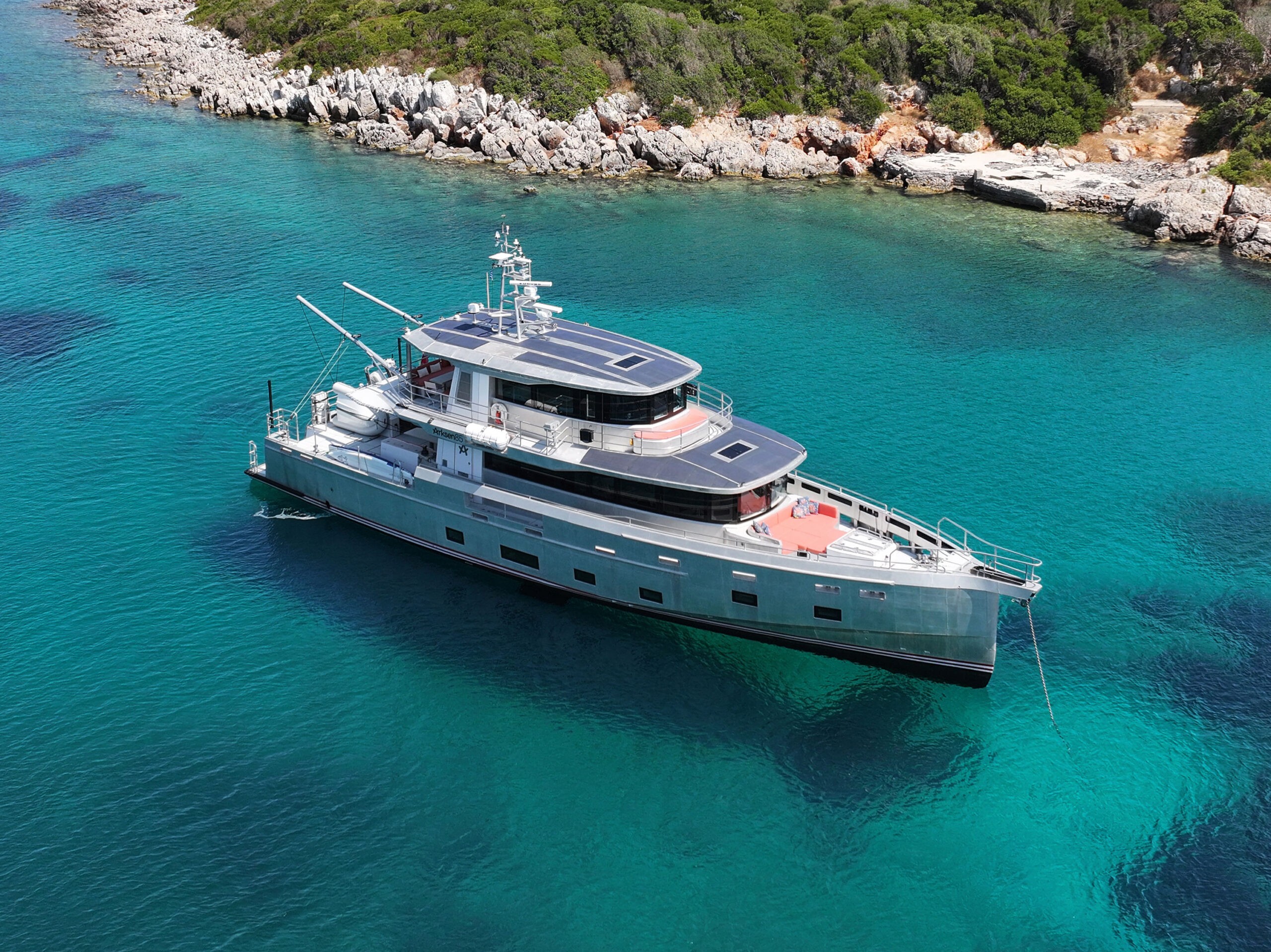
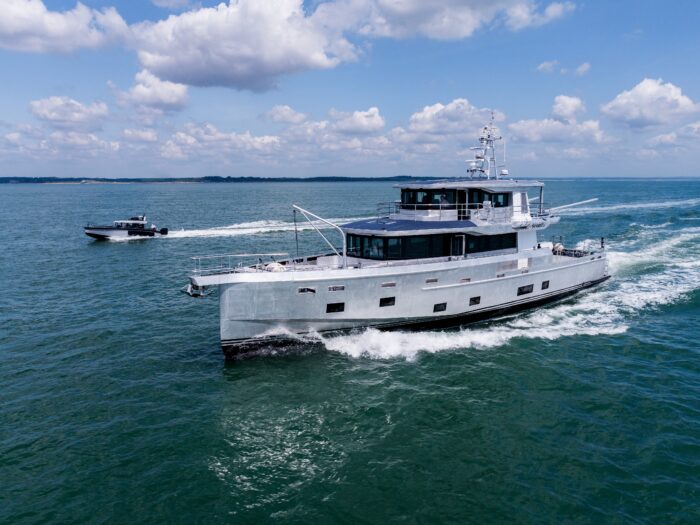
In addition, “for larger, more serious expedition yachts, steel is often preferred because of its strength, durability, and repairability. Aluminium can be excellent for lighter, fast, long-range yachts, like the Arksen 85, but the right material depends on the intended programme.”
What are the most important specs on an explorer yacht?
Ask any experienced broker or captain to name the single most important specification for a first-time buyer, and most will tell you the same thing.
“Range and autonomy,” says Sam. “You need to know the boat has enough fuel to get you where you want to go—and back safely—but autonomy goes beyond fuel. It’s stores, cold storage, watermaking, spare parts, medical capacity, crew welfare, waste management. If you’re going somewhere remote, you’ve got to be self-sufficient for weeks, not days.”
The headline range figure quoted in listings, often expressed in nautical miles at a given cruising speed, is a starting point and not necessarily a guarantee, so it’s essential buyers ask for real-world range under typical conditions at normal cruising speed.
Beyond range, the specs that matter most are:
- Stabilisation
Active stabiliser systems—whether fins, gyros, or zero-speed systems—are just as much about safety as they are comfort on board an expedition yacht. Confirm the systems are maintained, have a service history, and have spare parts available offshore.
- Engineering redundancy
A yacht destined for the Mediterranean can survive a watermaker failure or a generator fault when help is nearby. But on an expedition yacht, redudancies are in place to prevent real emergencies. Look for twin watermaker systems, at least two generators capable of sustaining the vessel’s functions independently, back-up navigation capacity, and duel communications.
- Heating
Most conventional yachts are designed for warmer climates and so are fitted with air conditioning only. Any vessel intended for higher latitudes, however, needs proper central heating.
- Communications
Starlink may have transformed offshore connectivity for yachts, but it carries no contractual guarantees, so Sam recommends VSAT.
“Starlink’s very good, and it’s fine for the Med,” Sam says. “There, if it breaks or shuts down, you have your phone. But if you’re going offshore, you need a back up. If you have VSAT, you’re guaranteed to have service, and if it goes down, they’re contractually obligated to fix it.”
- Propulsion
Shaft drives are generally preferred over pod systems: “The less mechanical stuff you have outside the hull, the better. If you hit something, there’s less chance of anything going wrong. It’s just a bit safer.”
- Tender launch and recovery
The ability to deploy and recover tenders safely in any sea state is a non-negotiable, says Sam; bow crane systems that work well in calm conditions can become a problem in two-metre swells. Davit placement, rescue tender access, and man-overboard capability should be part of any full evaluation.
Ice class ratings explained
Ice class is one of the most widely misunderstood specs on explorer yachts.
How the IACS Polar Class system works
The primary framework you’ll encounter is the Polar Class (PC) system, developed by the International Association of Classification Societies (IACS) in line with the International Maritime Organisation’s—the IMO’s—Polar Code, mandatory for commercial vessels operating in polar waters since January 2017.
The system establishes seven standard ratings. PC 1 is the highest, permitting year-round operation in all polar waters, including the most severe “multi-year ice”: that is, sea ice that has survived at least one summer without melting, making it harder and more dense than first-year ice, and the most dangerous environment for navigation. PC 7 is the lowest, permitting summer and autumn operations in thin, first-year ice.
The levels in between are a sliding scale of various structural reinforcements, propulsion power, and operational capability. PC 6, for instance, covers summer and autumn operation in medium first-year ice that may have older ice inclusions.
Each of the major classification societies—Lloyd’s Register, Bureau Veritas, DNV, and ABS, among others—issues its own ratings, but align them with IACS’ requirements. But what the class certification states and what the hull can actually withstand are not always the same thing, particularly on vessels built before 2007, when the unified requirements came into effect. Pre-2007 vessels may carry older society notations that don’t map directly onto the current PC scale.
What ice class rating does a private explorer yacht actually need?
For private expedition yachts, the question is not whether a vessel can actively break ice. PC 1 and PC 2 are generally associated with very serious polar-capable vessels and are unlikely to be relevant for most private yacht programmes.
Instead, the question should be: what level of ice-strengthening is appropriate for you?
“The mistake is in thinking you need the highest,” says Sam. “You need to look at your use case: where are you going? When do you want to go? What conditions are you likely to encounter? Most private yachts will need a fairly low PC rating—but that’s all you need because you’re risk isn’t smashing through multi-year pack ice, it’s encountering brash ice, growlers, and first-year sea ice in a seasonal window. A PC 6 or 7 covers most of that. What matters is that it’s documented, current, and that you’ve had a proper technical review of what that permits—and what it doesn’t.”
It’s also worth nothing that over-specifying ice class adds cost in build, insurance, and maintenance, all without any real benefit. You use should determine the spec, not the other way around.
A qualified surveyor or experienced yacht management partner will review the classification history, confirm the class is current and up-to-date, and advise on the specific operations the yacht is certified to undertake.
New build versus pre-owned explorer yachts
The case for new build
A new-build explorer yacht from a reputable shipyard offers full customisation and a documented build history from the keel up.
The disadvantage is time. Serious expedition-ready specs typically require three to five years from contract to delivery at a major yard, though specialist builders like Arksen can deliver sooner. For complex, polar-capable projects, that timeline can be longer.
If you know exactly what you want and can plan around a multi-year lead time, new build can offer good value per specification.
The case for pre-owned
A vessel with a proven track-record—demonstrably used in the waters it was built for, with a complete maintenance history and current class record—offers something a new build can’t: proof the specs work in practice.
“Check the logbook,” Sam advises. “A yacht that says it’s an ice-class explorer yacht should’ve actually been there.”
Due diligence on a pre-owned explorer yacht is more intensive than a comparable motor yacht designed for simple cruising, but the principles are the same:
- Review all class survey reports and maintenance records
- Confirm all planned maintenance is current
- Inspect the spare parts inventory
- Check all safety and medical systems are fully operational and in date
An experienced surveyor with specific explorer yacht knowledge will be well versed in what you need to look out for.
Commercial vessel conversions & refits
A third route worth considering is converting an existing commercial vessel.
Former offshore support ships and research vessels often have exceptional engineering packages; think commercial-grade redundancies, structural robustness, and propulsion systems designed for sustained operations in challenging conditions. SKY is a good example; the former offshore vessel would make for a perfect support yacht.
The trade-off is comfort and habitability. Commercial hulls are designed for function first, not comfort, so noise, vibrations, and interior finishes often leave something to be desired. That usually means significant investment to bring it up to private yacht standards.
“The engineering will be solid,” says Sam. “You can bold on the interior and make it nicer. But if you plan to turn up in Saint Tropez, it’s probably better suited to somewhere else.”
What does an explorer yacht cost?
Yachts designed for expeditions generally cost more to acquire and more to run than comparable conventional motor yachts of equivalent length.
Purchase price
Pre-owned explorer yachts in the 30- to 40-metre range sit in a broad bracket from approximately €3 to €15 million, depending on the age, builder, specs, and condition.
In the 40- to 60-metre range, prices span from roughly €10 to €40 million and above. Polar-capable, well-maintained vessels with documented expedition history and full class certification command a premium over comparable tonnage without that pedigree.
New-build pricing is best addressed directly with a broker once you have your specs in hand.
Running costs
Running costs for explorer yachts are generally higher than for conventional motor yachts of a comparable size, but not uniformly so.
Fuel burn per nautical mile at displacement cruising speeds is substantially lower than that of a planing or semi-planing yacht pushed hard between ports.
Where costs increase are in crew certifications (ice pilots, medical personnel, and those with enhanced qualifications for remove operations all add to crew budgets); insurance premiums for higher-risk operating areas; permits and cruising fees in environmentally regulated zones; and the ongoing cost of maintaining a fully stocked spare parts inventory.
“You’ll save on fuel per mile because explorer yachts go slow by design,” Sam explains. “But in going further, you’re burning more overall. The crew will need additional certifications; insurance premiums will be higher. Permits in remote or protected zones add up too. But while they may be more expensive in general to run, you’re doing a lot more with them.”
Charter income is a meaningful consideration if you’re weighing the cost of ownership. Explorer yachts with proven track itinerary track records—Norway, Greenland, Patagonia, the Chilean fjords, even Antarctica—attract strong demand from a growing charter market. A well-managed charter programme can general income that offset running costs.
What experienced buyers wish they’d known
The single piece of advice that comes up most often, once buyers have been through the process, is deceptively simple: start with the programme, not the yacht.
“The biggest mistake is seeing a yacht advertised as an explorer yacht and thinking, great, I’ll buy it,” Sam says. “And then it turns out its a normal yacht with aggressive exterior styling and some marketing behind it. Really, you need to define what you want to do first, then find the vessel, not the other way around.”
That means being specific on where you want to go, with how many guests, and for how long. Is the water hot or cold? Do you want to support the operation with tenders, subs, helicopters? What’s your honest trade-off between comfort and capability?
The answers to those questions will guide you to the right yacht.
“The other thing buyers consistently wish they’d interrogated more thoroughly is provenance,” Sam explains. “An explorer yacht’s paper trail matters moret than it does on a conventional motor yacht. Take your time—just really scrutinise it.
“The best explorer yachts aren’t the most extreme, they’re the ones best matched to what you actually intend to do.”
Thinking about buying an explorer yacht?
Browse our explorer yachts for sale—including the Arksen 85, SKY and PROJECT ZEPHYR—or speak to our sales team about your specific needs.
 Previous news article